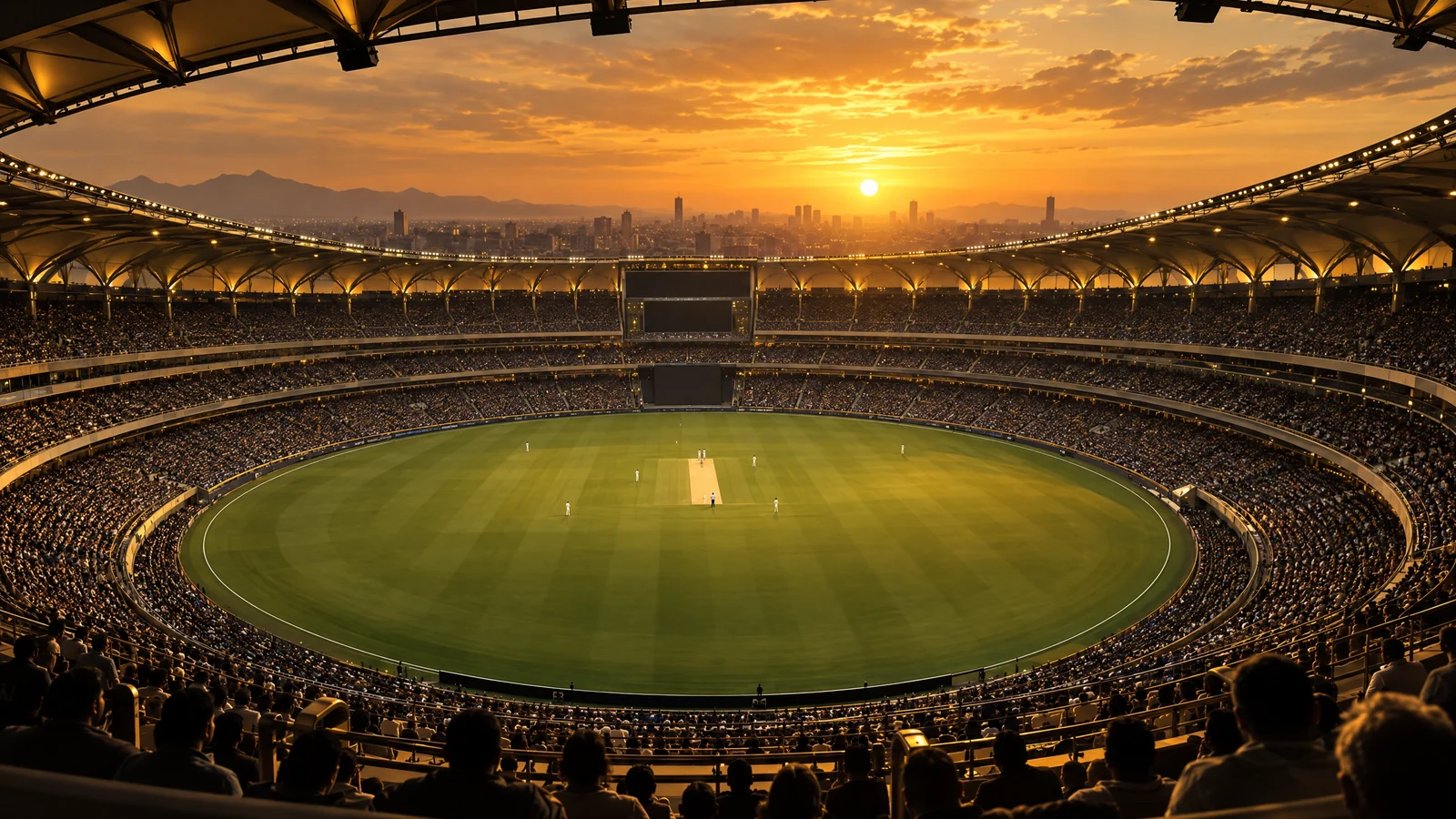
Original editorial illustration; not a photograph of a named player, match or stadium.
By Reddy Book Editorial Team
Figures checked: 10 November 2026, 4:25 PM IST
Ranking basis: Current published spectator or seating capacity for operating cricket venues
The biggest cricket stadium in this checked selection is Narendra Modi Stadium in Ahmedabad, with a published capacity of 132,000. Melbourne Cricket Ground follows with 95,000 seats, although its operator also describes about 5,000 standing spaces and a 100,024 total capacity. Those figures illustrate the main point of this cricket guide: capacity depends on what a venue is counting.
This list ranks ten operating cricket venues by a current published spectator or seating figure. It is not a ranking of boundary size, match attendance, atmosphere or likely crowd. Where a venue publishes more than one meaningful number, the distinction is kept beside the entry so readers can compare like with like.
How to read a cricket stadium capacity list
A capacity may refer to seats, a maximum event configuration or a wider spectator total. The list uses an explicitly published seating figure when one is available. That is why the MCG is ranked on 95,000 seats rather than its 100,024 total, and why Optus Stadium is ranked on 60,000 seats rather than a sometimes-quoted event configuration.
Raipur is marked provisional because one source gives 65,000 in the ground-page body while its metadata gives 50,000. Ekana also has two current published figures: BCCI lists 50,100, while the International Cricket Council lists 50,000. These are source differences worth showing, not numbers to quietly combine.
At the tenth-place cutoff, Barabati Stadium and DY Patil Stadium share a published 45,000 capacity. Barabati is the alphabetically selected tenth main profile, while DY Patil is an equal-capacity peer. Hyderabad is not placed in the list because BCCI’s current directory gives 39,200 while an ICC venue page gives a maximum of 55,000. JSCA International Stadium Complex is also left out because the accessible figures conflict and the official association material checked did not settle its capacity.
Top 10 biggest cricket stadiums by published capacity
1. Narendra Modi Stadium — Ahmedabad, India — 132,000
Narendra Modi Stadium leads this selection at 132,000 spectators on the BCCI venue directory. The Gujarat Cricket Association describes a major reconstruction: the original stadium was built in 1982, redevelopment began in 2015 and the rebuilt venue was completed in February 2020. BCCI also describes renovation work in 2021, so the present venue is best understood as a transformed ground with a long site history.
That history reaches across generations. The Gujarat Cricket Association records Sunil Gavaskar reaching 10,000 Test runs and Kapil Dev taking his 432nd Test wicket at the older ground. Capacity explains why the venue ranks first; it does not by itself describe match quality or the experience of a particular crowd.
2. Melbourne Cricket Ground — Melbourne, Australia — 95,000 seats
The Melbourne Cricket Ground ranks second on its operator’s published 95,000 seats. The same operator describes about 5,000 standing spaces, producing a 100,024 total capacity. This article uses the seated figure for the ranking and keeps the total as context because the two measures answer different questions.
The MCG was built in 1853. Cricket Australia’s venue material identifies it as the site of the first Australia–England Test in 1877 and as a Melbourne Stars home in the Big Bash League. Readers following the Australian domestic competition can use this BBL cricket reference for that wider context; the venue’s place here is determined by its published seats.
3. Eden Gardens — Kolkata, India — 68,000
Eden Gardens is third at the current BCCI-published capacity of 68,000. Older reports have used 66,000, while a proposed future figure of 85,000 is excluded because this list describes the current published venue rather than an uncompleted redevelopment.
The Cricket Association of Bengal records the ground’s first Test, India versus England, from 5 to 8 January 1934. It also records the first India–Pakistan ODI there in February 1987 and the first T20I at the venue, India versus England, in October 2011. BCCI material identifies Eden Gardens as the 1987 World Cup final venue, giving the capacity figure a substantial cricket history behind it.
4. Shaheed Veer Narayan Singh International Cricket Stadium — Nava Raipur, India — 65,000 reported, provisional
The Nava Raipur stadium is fourth on a widely reported 65,000 figure, but the number needs a visible qualification. NDTV’s ground-page body gives 65,000 while its metadata gives 50,000. The selection therefore uses 65,000 as a reported figure and labels the rank provisional; it is not presented as settled installed seating.
NDTV dates construction to 2008 and the first match to 2010. Indian Express describes the venue’s use for IPL, ODI and international T20 cricket. That combination gives Raipur a role in both major domestic franchise cricket and international scheduling, even while the published capacity remains qualified. The separate IPL format guide provides competition context rather than changing the venue figure.
5. Optus Stadium, also called Perth Stadium — Perth, Australia — 60,000 seats
Optus Stadium ranks fifth on the operator’s explicit 60,000-seat figure. Some listings use 61,266 for an event configuration, but that is not treated as identical to seated capacity here. Keeping the measures separate makes this entry comparable with venues that publish seats directly.
Construction began in December 2013 and the stadium opened on 21 January 2018. The operator presents it as a modern multipurpose venue with international cricket and Big Bash League use. In cricket terms, it is the large contemporary Perth venue rather than the older WACA Ground, so the two should not be merged into one capacity entry.
6. Adelaide Oval — Adelaide, Australia — 53,500
Adelaide Oval is sixth with Cricket Australia’s published 53,500 capacity. Other references sometimes use 53,583, but this article uses the board’s rounded published figure rather than implying that a rounded number is an exact seat-by-seat survey.
The ground remains a regular Test, ODI and Big Bash venue. An Adelaide Oval education publication records a redevelopment completed in 2014, which explains the modern stadium’s place in a much older cricket setting. Its position here comes from the combination of a substantial published capacity and continuing roles across international and domestic cricket.
7. Bharat Ratna Shri Atal Bihari Vajpayee Ekana Cricket Stadium — Lucknow, India — 50,100
Ekana is seventh on the BCCI’s 50,100 figure. The ICC publishes 50,000, so both numbers belong in the note. The 100-seat difference is treated as a published-source variation, not evidence of a newly built extra section or a settled physical count.
Official material places the venue’s construction or opening in 2017. It serves Uttar Pradesh cricket and the Lucknow Super Giants, while ICC material records Afghanistan’s home use in 2019. The venue was also renovated for the 2023 World Cup, adding to its role in India’s international cricket infrastructure.
8. Greenfield International Stadium — Thiruvananthapuram, India — 50,000
Greenfield International Stadium ranks eighth at 50,000. The figure is supported by the BCCI directory and a Kerala Cricket Association catering document for an international match in December 2025. Older ground profiles sometimes give 55,000, but that older number is not used for this current published-capacity list.
Also known as The Sports Hub, Trivandrum, Greenfield is a cricket and wider sports venue. Kerala Cricket Association material confirms its completed project status and international women’s T20I use. The relevant point is that 50,000 is the checked current basis and the venue continues to serve cricket, not that every older listing uses the same figure.
9. Barsapara Cricket Stadium — Guwahati, India — 46,000
Barsapara Cricket Stadium is ninth on the current BCCI-published figure of 46,000. ESPNcricinfo’s ground profile lists 40,000, so 46,000 is described as the BCCI figure rather than an undisputed physical capacity.
The ground is also known as Dr Bhupen Hazarika Cricket Stadium and Assam Cricket Association Stadium. It functions as a recurring international and Assam cricket venue. Those names can make searches confusing, but they refer to the same Guwahati entry in this list; the capacity note keeps the naming and numerical differences visible.
10. Barabati Stadium — Cuttack, India — 45,000
Barabati Stadium takes the tenth main-profile place at the BCCI-published 45,000 capacity. The choice is alphabetical at a tied cutoff: DY Patil Stadium’s current operator also publishes 45,000. DY Patil is therefore an equal-capacity peer, not a smaller venue. Legacy material for DY Patil has also used 55,000, which is why that older number is not substituted into this current-operator comparison.
BCCI records Barabati’s first ODI in January 1982 and first Test in 1987. The ground has also hosted regular ODI cricket and a 2013 Women’s World Cup match. Those milestones show its cricket role without requiring a claim about an exact opening year or future fixtures.
Why some well-known venues are not ranked here
A capacity list becomes difficult to compare when every published number is treated as interchangeable. Rajiv Gandhi International Cricket Stadium in Hyderabad is the clearest example in the checked material: BCCI lists 39,200, while an ICC 2023 World Cup venue page gives a maximum of 55,000. It is excluded under the current-board-figure rule because the two figures describe different bases; the exclusion does not settle the venue’s capacity beyond dispute.
JSCA International Stadium Complex in Ranchi is also excluded. The official association confirms venue use, but the accessible capacity evidence conflicts: NDTV’s body gives 35,000, its metadata gives 50,000 and a 2019 report cites a 39,000-seat figure. Without choosing one disputed number, placing it in a top ten would give readers a false sense of precision. The stadium’s omission here is about unresolved capacity evidence, not whether it hosts cricket.
What capacity tells a cricket reader
Capacity is a scale measure. It helps compare the published spectator size of venues and shows why rebuilt mega-stadiums, historic grounds and modern multipurpose arenas can appear together in one list. It does not describe boundary dimensions, pitch behavior, attendance at a particular match or which side will win.
The paired guide to men’s T20I career run-scorers applies the same idea to a different cricket statistic: define the scope, state the date and explain source differences. For readers who want to understand match displays and score summaries, the guide to reading scoreboard and match updates is an educational companion, not a capacity tracker.
For the wider sports resource, readers can visit ReddyBook. This article’s figures remain tied to the dated published venue information above.
FAQs about the biggest cricket stadiums
Which is the biggest cricket stadium in the world by published capacity?
Narendra Modi Stadium in Ahmedabad leads this checked selection with a published capacity of 132,000. The ranking uses current published spectator capacity and does not claim that capacity alone measures a venue’s cricket quality or match atmosphere.
Why is the MCG listed at 95,000 instead of 100,024?
The MCG operator distinguishes 95,000 seats from about 5,000 standing spaces, giving a total capacity of 100,024. This list ranks venues using seats where a separate seated figure is provided, so it uses 95,000 and records the total as context.
Is Shaheed Veer Narayan Singh Stadium definitely a 65,000-seat venue?
Not on the evidence used here. NDTV’s ground-page body reports 65,000, while its metadata reports 50,000. The article uses 65,000 as a reported provisional figure and places the conflict beside the ranking rather than presenting the installed seating as settled.
Why are Ekana and Greenfield both near 50,000 but treated differently?
BCCI publishes Ekana at 50,100 and the ICC at 50,000, so the difference is acknowledged. Greenfield is ranked at 50,000 from current BCCI and Kerala Cricket Association material; older 55,000 figures are excluded. Each entry follows the selected current-source basis.
Why is DY Patil not one of the ten main venue profiles?
DY Patil’s current operator publishes 45,000, tying Barabati. The list selects Barabati alphabetically for the tenth profile and names DY Patil as an equal-capacity peer. It does not claim DY Patil is smaller or absent from cricket use.
Does this list rank stadiums by playing area or likely attendance?
No. It ranks selected operating venues by current published spectator or seating figures. Playing area, boundary length, attendance records, weather, pitch behavior and match outcome are outside the ranking basis.